

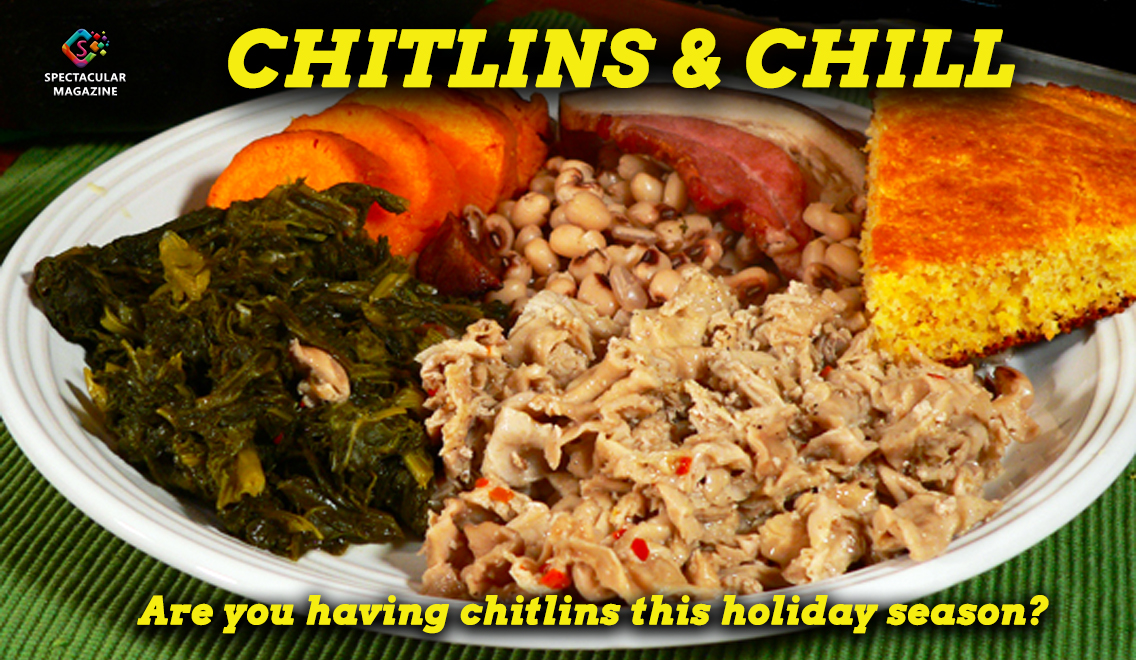
Chitlins & Chill: Why Black Folks Should Be Free to Enjoy the Holiday Classic in Peace

Every year around the holidays, kitchens across Black America become battlegrounds — not over politics, not over football, but over food. Specifically, whether or not it’s still okay to eat chitlins. The debate runs hotter than grandma’s cast-iron skillet, with one side declaring them a sacred Southern delicacy and the other side clutching their pearls (and air freshener). But let’s be clear — if chitlins are on your holiday table, you’ve earned the right to enjoy them in peace.
A Delicacy With Deep Roots
For the uninitiated, chitlins — short for chitterlings — are pig intestines cleaned, seasoned, and slow-cooked into savory, soulful goodness. The aroma? Intense. The texture? Divisive. The cultural significance? Undeniable.

Long before they became a punchline on social media, chitlins were a symbol of survival and creativity. Enslaved Africans took the least desirable parts of the hog and turned them into something that fed generations — both literally and spiritually. Over time, chitlins became a dish reserved for celebrations: Thanksgiving, Christmas, and family reunions — occasions steeped in love, laughter, and the joy of gathering.
A Dish That Defines Us — For Better or Worse
Now, we know the arguments. “We ain’t slaves no more.” Or the ever-popular, “I don’t eat struggle food.” And sure, the smell isn’t winning any awards. But let’s not rewrite history just because the scent makes you open a window. Chitlins remind us that our ancestors took what they were given and made it glorious.
Besides, how can we celebrate soul food culture — from barbecue to gumbo to jambalaya — and act brand new about chitlins? You don’t have to eat them, but don’t side-eye those who do. It’s not about poverty or pain. It’s about pride, perseverance, and a pot of something seasoned to perfection.
Healthier Choices Don’t Mean Cultural Amnesia

No one’s saying make chitlins your new kale. Let’s be real — they’re not exactly heart-healthy. High in sodium? Yes. Smell outrageous? Also yes. But in moderation, on a holiday, shared with family? That’s heritage on a plate.
Millennials and Gen Z may be trading soul food Sundays for smoothie bowls, but that doesn’t mean we throw away the traditions that made us. You can care about your cholesterol and your culture at the same time.
So, Eat Your Chitlins and Mind Your Business
At the end of the day, chitlins are more than food — they’re a conversation, a memory, a bridge between generations. Whether you’re lighting candles, frying fish, or boiling chitlins this season, do it with pride.
Because if you’ve ever had to clean them, cook them, and survive that smell — you’ve earned every bite.
So go ahead. Eat your chitlins in peace. And for those who can’t handle it — just crack a window and keep scrolling.
Whether you love them or can’t stand the smell, this Southern delicacy still stirs up strong opinions and cultural pride. So, what’s your take — are chitlins still welcome at your holiday table? Share your thoughts in the comments below.