

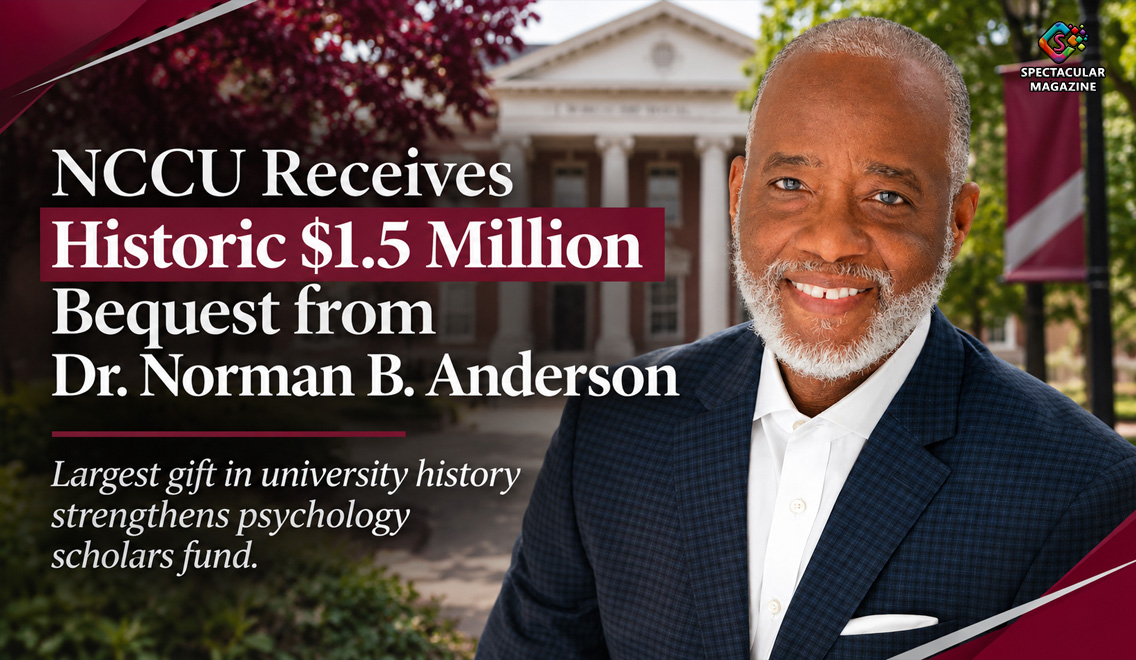
NCCU Receives Historic $1.5 Million Bequest From Distinguished Alumnus Dr. Norman Anderson

DURHAM, NC — North Carolina Central University (NCCU) has received a historic $1.5 million bequest from distinguished alumnus Dr. Norman B. Anderson, marking the largest bequest in the university’s history and creating a lasting legacy of educational opportunity for future generations of psychology students.
Anderson, a 1977 NCCU graduate who died in 2024, directed the gift through his estate to the Dr. Norman B. Anderson Psychology Scholars Fund, an endowment he established during his lifetime.
The fund is designed to help NCCU students gain valuable research experience and become more competitive when applying to doctoral programs in psychology.
A Historic Investment in NCCU Students
The $1.5 million contribution represents more than a record-setting gift. It reflects Anderson’s commitment to expanding opportunities for students at his alma mater, particularly those pursuing advanced education and research careers.
By strengthening the existing endowment, Anderson’s estate gift will provide long-term support for aspiring psychologists while reinforcing NCCU’s commitment to academic excellence.
“Dr. Anderson’s extraordinary legacy reflects the power of education to shape lives, influence fields of study and create lasting change,” said NCCU Chancellor Karrie G. Dixon.
“We are deeply grateful for his decision to invest in North Carolina Central University in such a meaningful and enduring way. His generosity will help strengthen the university’s future while honoring the remarkable life and accomplishments of one of our distinguished alumni.”
From Greensboro to National Leadership
A native of Greensboro, North Carolina, Anderson earned his undergraduate degree from NCCU in 1977 before obtaining both a master’s degree and a doctorate in clinical psychology from the University of North Carolina at Greensboro.
He later completed clinical residency training at Brown University School of Medicine and a postdoctoral research fellowship at Duke University School of Medicine.
Anderson built an influential career spanning scientific research, public health, higher education, and executive leadership.
His accomplishments included serving as:
- Associate director of the National Institutes of Health (NIH)
- First director of the NIH Office of Behavioral and Social Sciences Research
- Professor at the Harvard School of Public Health
- Chief executive officer and executive vice president of the American Psychological Association, a position he held for 13 years
His research explored the connections between stress, health and the experiences of African Americans, including the role of racism as a source of stress and its implications for physical and psychological well-being.
A Legacy of Excellence and Recognition
Anderson’s contributions earned him numerous prestigious honors throughout his career.
He was elected to the National Academy of Medicine in 2012 and inducted into the National Black College Alumni Hall of Fame in 2013.
In 2023, he received the Scientific Impact Award from the Society of Experimental Social Psychology, recognizing his contributions to scientific research.
His professional achievements also included four honorary doctorates, along with numerous fellowships and distinctions.
A Gift That Will Benefit Generations
Although Anderson’s career reached national and international audiences, his decision to support NCCU through his estate demonstrated his enduring connection to the historically Black university that helped launch his professional journey.
His $1.5 million bequest will strengthen a scholarship and research endowment intended to prepare future generations of psychology scholars for advanced study and professional success.
The historic contribution also underscores the potential of planned giving and alumni philanthropy to expand educational opportunities long after a donor’s lifetime.
For more information about North Carolina Central University, visit www.nccu.edu.