

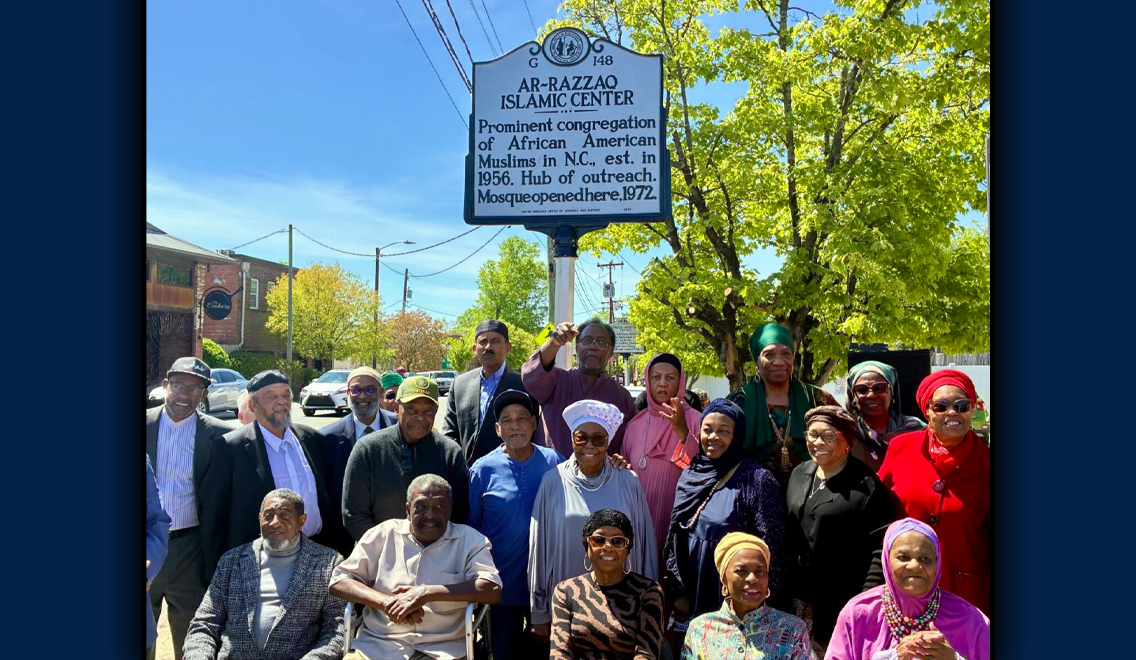
NC Honors Durham’s Ar-Razzaq Islamic Center, First Mosque in State, With Historic Marker
DURHAM, N.C. — A powerful piece of North Carolina history is finally receiving long-overdue recognition. More than 70 years after its founding, Durham’s Ar-Razzaq Islamic Center has been officially honored with a state Highway Historical Marker—recognizing it as North Carolina’s first mosque and a cornerstone of the state’s African American Muslim legacy.
A Historic Moment in Durham’s West End

Cheers of “Allahu akbar!” filled the air Friday afternoon as community members gathered in Durham’s West End for the unveiling of the historic marker.
The recognition, issued by the N.C. Department of Natural and Cultural Resources, places Ar-Razzaq among more than 1,600 historical markers statewide—but its significance runs far deeper.
A Legacy Rooted in Faith and Community
Founded in 1956 by Imam Kenny Muhammad, Ar-Razzaq Islamic Center has long served as a spiritual and cultural anchor for Black Muslims in North Carolina.
For decades, the mosque has helped shape:
- The growth of Islam across the state
- Community uplift and education
- Interfaith and cultural understanding
“It is heartwarming… a manifestation of devotion and dedication,” said Rhonda Muhammad, daughter of the founding imam.
“My father didn’t work for recognition—he worked for the uplifting of humanity.”
From Nation of Islam to Broader Faith Community
Ar-Razzaq began as part of the Nation of Islam before transitioning in the late 1970s to mainstream Sunni Islam, expanding its reach and perspective.
That shift marked a turning point.
- The mosque became more religiously focused than socially structured
- It built connections with broader Muslim communities nationwide
- It helped reshape perspectives within its own congregation
“It broadened our horizons… created a whole new way of thinking,” Muhammad said.
A Civil Rights-Era Landmark

Ar-Razzaq’s story is deeply intertwined with the Civil Rights Movement.
Originally located on West Pettigrew Street in Durham’s historic Black Wall Street, the mosque later moved to Chapel Hill Street in 1972, where it remains today.
During the 1960s, the mosque drew influential figures including:
- Malcolm X
- Muhammad Ali
When institutions like Duke University, UNC, and NCCU declined to host Malcolm X due to controversy, Ar-Razzaq leaders helped ensure his voice was still heard in Durham.
A Broader Impact Across North Carolina
Ar-Razzaq’s influence extended beyond Durham.
- Leaders helped establish the first mosque and Muslim school in Raleigh in 1971
- The mosque played a role in shaping Black Muslim identity in the South—a region often overlooked in historical narratives
Today, it stands as a rare and enduring example of a Southern Black Muslim community that has thrived since the 1950s.
Why This Recognition Matters
The new historical marker, located on Chapel Hill Street near Al-Taiba Halal Market, does more than mark a place—it tells a story.
“Historical markers educate the public, preserve shared memories, and help communities understand their past,” said mosque member Aleah Marrow.
The recognition also highlights the need to elevate local histories that have long been overlooked.
Conclusion
The unveiling of Ar-Razzaq Islamic Center’s historical marker is more than a ceremonial moment—it’s a restoration of visibility. As Durham continues to celebrate its rich cultural legacy, this recognition ensures that the contributions of its African American Muslim community are not only remembered but honored for generations to come.