

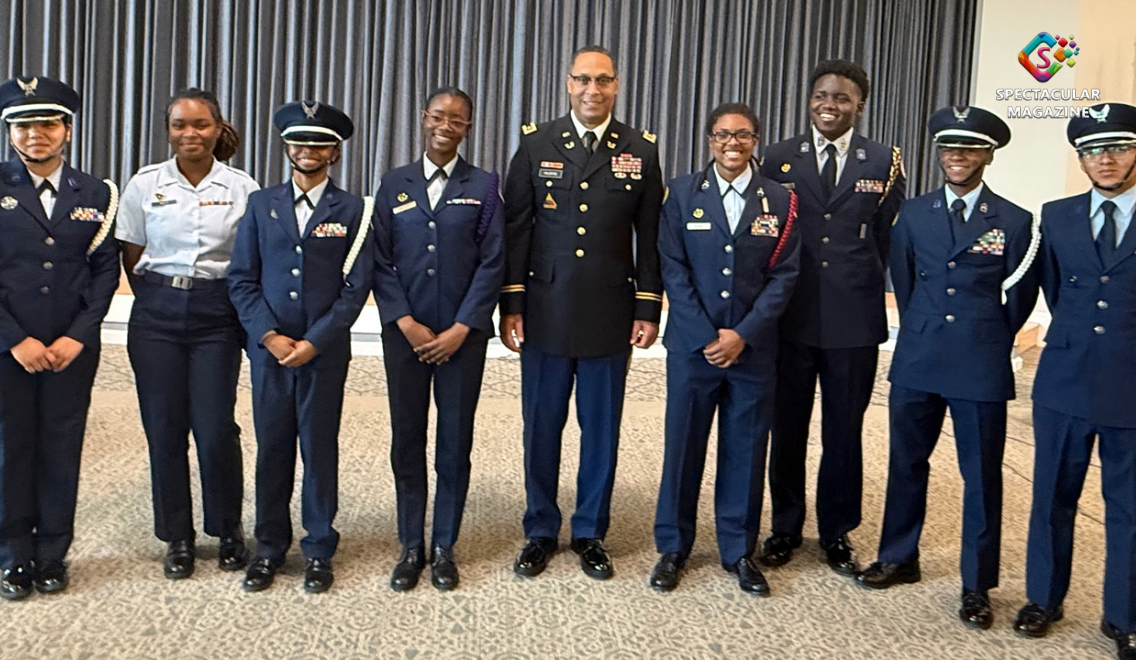
Durham County Commissioner Stephen Valentine Returns to Uniform to Honor the Fallen on Memorial Day
Durham, N.C. — Durham County Commissioner Stephen J. Valentine stepped back into his Army Dress Blue uniform for the first time in nearly a decade this Memorial Day, participating in a series of solemn ceremonies honoring the nation’s war dead. For Valentine, the day carries profound personal meaning rooted in a family legacy of military service and sacrifice.
Honoring 376 Durham County Service Members
Valentine joined county leaders Monday morning for Durham County’s annual Memorial Day observance, a ceremony dedicated to the 376 known service members from Durham County who lost their lives while serving in the Armed Forces. Each name was read aloud during a roll call, a moment Valentine described as a reminder of “376 empty chairs at Durham dinner tables over the generations—376 lives cut short.”
The ceremony concluded with a formal wreathlaying at the county’s war memorials. Commissioner Valentine, Commissioner Wendy Jacobs, and County Manager Claudia Hager stood together as “Taps” echoed across the memorial grounds.
A Personal Legacy of Service
Following the county observance, Valentine traveled to Croasdale Village, where he delivered Memorial Day remarks to a packed audience. He admitted with a smile that he was initially reluctant to retrieve his Army uniform from the closet after nearly ten years, unsure whether it would still fit. “Much to my surprise,” he said, “I was able to make it work for the occasion.”
Memorial Day holds deep significance for Valentine because of his family’s long tradition of military service:
• His father served in the United States Marine Corps
• His brother, James A. Valentine, retired from the United States Navy
• Three of his father’s brothers served during World War II
• His uncle, William M. Valentine, survived WWII only to perish as a POW during the Korean War

It is the story of his uncle William that most profoundly shapes Valentine’s understanding of the holiday.
The Story of William M. Valentine
William M. Valentine was captured on December 1, 1950, during the brutal Battle of Chosin Reservoir in Korea. He died in captivity in a North Korean POW camp. Public records indicate that his remains were recovered in February 1951 and returned to the United States in 1955.
Yet the family never found closure. Valentine recounted that his grandmother, Lorena Valentine, never believed the remains in the casket were truly her son’s. “She lived out the remainder of her life believing that he would walk through the door of the family home,” he said.
William’s name is now enshrined on the Korean War Memorial in Washington, D.C. The SladeValentine American Legion Post #336 in Burlington City, New Jersey, bears his name, and he is interred at Beverly National Cemetery. His service in the 24th Infantry Regiment, 25th Infantry Division—the last segregated unit in the U.S. Army—adds historical weight to his story.
A History of Memorial Day, Revisited
During his remarks at Croasdale Village, Valentine offered a powerful reflection on the origins of Memorial Day—history he noted is often overlooked.
“Today, we remember those who died for our independence and the opportunity to participate in the world’s first great experiment with selfrule,” he said, noting the significance of the upcoming 250th anniversary of the United States. “For two and a half centuries, that experiment has endured not by accident, but because every generation has produced men and women willing to seal that democratic promise with their own blood.”
Valentine traced the holiday’s roots to the aftermath of the Civil War, the deadliest conflict in American history, with an estimated 750,000 soldiers killed. He highlighted the first known Memorial Day observance on May 1, 1865, when formerly enslaved Americans in Charleston, South Carolina, reburied Union soldiers who had died in a Confederate prison camp and held a parade of 10,000 people to honor them.
Three years later, in 1868, General John A. Logan established Decoration Day, which evolved into Memorial Day. Congress later formalized the holiday in 1971.
A Call to Remember—and Serve
Valentine closed his remarks with a reminder that remembering the fallen is not merely an act of solemn remembrance, but a civic responsibility.
“Today, we remember those Civil War dead, and it is my prayer that we heed the lessons of history so that we may never repeat them,” he said. “Their courage and commitment will never be forgotten.”
For Valentine, the legacy of his family’s service continues to shape his own path. He credits that tradition of sacrifice and selfless service as a driving force behind his commitment to public service in Durham County.
การลงทุนกับ JokerSlotz 999 ยอมรับว่าเป็น ตัวเลือก ยอดนิยม ในสมัยนี้ เพราะ กลไก การเข้าถึง
ซึ่งเป็นสิ่งที่ ง่ายดาย พร้อม ความเป็นไปได้ การทำกำไร ผลตอบแทน ก้อนใหญ่ เพิ่มเติม ยังคง จัดเตรียม ข้อเสนอพิเศษ จำนวนมาก เพื่อ ผู้เล่น หน้าใหม่ และ ผู้ใช้บริการ
ที่ใช้บริการอยู่แล้ว อีกด้วย